Monday, May 24, 2010

Hitler's Ukrainian swimming pool

Fifteen years ago I went to perhaps the creepiest place I have visited. Deep in a forest outside Kętrzyn in northern Poland are the shattered remains of Wolfschanze, the 'Wolf's Lair', Hitler's principal HQ during Barbarossa - a gloomy clearing where the guide will tell you 'Hitler lived there, Goering just across the road....', and where you can see the site of von Stauffenberg's failed bomb attempt. The Nazis did their best to blow it all up before they left, also generously seeding the surrounding area with landmines. These, I was told, were finally cleared by young Polish Pioneer 'volunteers' during the 1950s - perhaps the most macabre twist of all.

Lesser known is Hitler's Ukrainian HQ, Wehrwolf, near Vinnytsia in Ukraine, which I sought out on Sunday. Arriving in the town by train and wondering where I could get any information, I stumbled across the one institution which would certainly be able to tell me all about it - the local synagogue. Not only that, but Josef, who was hanging around in the office, had nothing to do and also had a car -he would take me there and show me around.

In the ten years 1935-1945 Vinnytsia saw as much or more cold-blooded murder as almost any other corner of Europe. The Nazis were delighted, on taking control of the region, to discover and publicize the mass graves of nearly 10,000 Ukrainians executed by the NKVD -Ukraine's Katyn. They went on vastly to exceed this terror with the murder of local Jews, Ukrainians and POWs. Like many other such towns in Poland and Ukraine, Vinnytsia's present relative prosperity belies its horrific past. Out along the main roads, smart new houses have been built - so you might not notice the sign indicating the sideroad to Wehrwolf. Indeed even if you saw it, you might wonder if you were on the right route, as the bright new villas continue up to and opposite the site.

Not that there turns out to be much to see. There is the open-air swimming pool (above) constructed for the Fuhrer's personal use, and a few scattered concrete blocks. As it happens, Hitler only spent a few weeks in total at Wehrwolf, and probably never used the pool - constructed, like the rest of the site, by forced labour. What the Nazis themselves didn't destroy, including the system of underground bunkers, was thoroughly dismantled by the Soviets. Rather more disconcerting than any potentially sinister remains was the number of local folk casually picnicking on the site, many equipped with portable barbecues.

Just the other side of the highway -and also surrounded by smart new housing, a hotel and a sports centre - Josef showed me another memorial, not directly visible from the road. It stands on another mass grave, where 14,000 Russians, Czechs, Poles, Norwegians and others were dumped by the Nazis. We walked meditatively away, to the plunk of volleys from the adjoining tennis courts.

Saturday, April 17, 2010

Dancing at Teatralna

Every Saturday night, just before seven in the evening, you will find a bunch of fifty or so senior citizens hanging around the underground concourse at the entry to Teatralna metro station in Kiev.

They are watching a group of five or six musicians - accordion, saxophones, tambourines - assemble in front of a baked-potato joint. At seven prompt, the band strikes up and the dancing begins. 'Why do you come here?' I ask an old lady (actually perhaps not much older than myself - or maybe even younger), partnering a similar cheerful biddy. 'Oh, it's just fun - and it doesn't cost anything. We're here every week' comes the reply. At eight o'clock the band packs up and five minutes later the concourse is empty.

Sunday, February 7, 2010

Vote, vote, vote.......

Last night I met with a guy who, depending on today’s result, could well become a leading figure in the new government – it doesn’t matter who, or which side he is on, because his counterpart would have said almost exactly the same - viz. ‘my candidate’s lead in private polls was 10-15%, but even a 5% margin would be more than enough to be definitive, wouldn’t it? – and by the way the other side is engaging in all sorts of dirty tricks, look, here’s a text I’ve just received showing what they are doing in Kharkiv, etc. etc. etc.’

This morning, election day, at around 10.00, the city was absolutely quiet – Independence Square, the birthplace of the ‘Orange Revolution’ (RIP) was deserted –

By 11.00 traffic at the polling stations was picking up however. I visited a few as a hanger-on to a European Parliament observer group led by Charles Tannock MEP. The polling stations are numerous – located in schools, each covering between about 1200 and 2500 voters. We called on them unannounced, some in the posh part of town, some in a less salubrious suburb. Although the ones in the centre (language schools, favoured by the families of diplomats and professionals) were clearly smarter, all of them seemed in good nick. The cleaning lady in one of the suburban schools was particularly delighted to welcome us and extol the virtues of her school – and also to recommend the buffet. It seems to me an excellent idea to enable voters to have a cup of tea and a bit of cake (at very reasonable cost – about 40p) after the exertions of voting, and it doubtless contributes to the school’s revenue - this is just one of the aspects of voting in Ukraine which the UK might well seek to adopt. It might even increase turnout.....

Voters (who have to identify themselves) report to a table covering their street – each table is manned by a representative of each candidate. Furthermore the presiding officer in each polling station is a nominee of one side, and the secretary is a nominee of the other. This political involvement in the mechanics of voting is a novelty to anyone used to the British system but it is in the circumstances a robust guarantee of fairness and transparency and in all the stations I visited there was clearly good cooperation between representatives of both sides, who were proud to be able to demonstrate to foreigners that democracy was working well. By midday, about 30% of voters had polled. The polling station committees seemed to agree this was a rather low figure, although by our standards it was high for that time of day.

As in the UK, the ballot papers are completed in individual booths. Voters have three choices, either of the candidates or ‘none of the above’. The ballot paper is then deposited by the voter in sealed, but transparent, ballot boxes. Many of the polling stations had special voting booths for the disabled. We were also told about the special service available for those who cannot attend to vote; there is of course no postal voting (one presiding officer was astounded to hear that a system so vulnerable to fraud was available in Britain), so polling station officials will visit the homes of the incapacitated to witness their ballot and place it in a special (portable) ballot box.

I noted an interesting cultural difference - in the UK we are used to folding the ballot paper before inserting it in the ballot box, presumably as some reflection of the secrecy of the ballot. Here, very few papers are folded - is that a hangover from the days of Communism, when in elections there was anyway only one candidate? In any case, this gives the opportunity to take a quick straw poll of the results. For what it is worth, Timoshenko seemed to have the lead in all of the polling stations, but more so in those in the centre of town. Out in the countryside, of course, or in eastern Ukraine, the story is likely to be rather different – but we shall know all within two or three hours of my finishing this report.

Wednesday, February 3, 2010

Ostorózhno, skól’zko!!


The first Russian phrase I recall hearing after I landed in a freezing Kaliningrad almost exactly seventeen years ago was "Ostorózhno, skól’zko!" (“watch out, it’s slippery”). The sound of the words is perfect, almost onomatopoeic, with the tiniest hint of a ‘w’ before the first ‘o’ in ‘skol’zko’ subtly suggesting sliding and slithering. It was highly appropriate on the pavements of that provincial Russian town so long ago, but the pavements of today’s Ukrainian capital are no better in icy weather – especially after a brief thaw which was followed by a re-freeze. Ironically in these conditions the worst parts are those which have been smartly repaved in modern tiles on which ice is not always visible and which do not even offer the tenuous hold offered by the pitted sidewalk tarmac elsewhere.

Here and there one sees the desultory scattering of a few handfuls of sand, or a lone fellow wielding an icebreaker, but these are of little avail in the general chaos. Most Kievians are resigned to trudging on regardless. Foolishly I attempted to walk to work in these conditions, a stroll which normally takes me half an hour, but on this occasion nearly double that. Two tumbles in swift succession, and three very near misses, have left me with aching bones and a black eye.
As I was scrabbling foolishly around on the ice trying to right myself, there stole into my mind a classic exchange from the Goon Show, in which Seagoon and co. are attempting to steal Napoleon’s piano but can’t get it through the door. After some sound effects of frantic sawing, Seagoon announces ‘There, I’ve cut off all four legs’. Grittpype-Thynne asks ‘But Neddy, doesn’t a grand piano have only three legs?’, at which Eccles announces ‘Hey, I keep falling over!’ I know just how he feels.

Saturday, January 23, 2010

Kiev for Nudniks, no. 486: On the Buses (2)

Now you can travel like a native on Kiev’s trolleybuses (see previous post) the company of hoi polloi may begin to pall, and you may set your sights on the more exclusive marshrutni bus, where the fare is a heady 2 grivnias (or maybe even 2 grivnias 50 kopecks). But before you graduate to this cynosure of public transport, it is essential for you to acquaint yourself with its very particular ethos.

The marshrutni (accent on the ‘u’), whose name derives I suppose from the French marche-route, is typically a twenty-seater minibus, with a standing capacity that seems to extend to about 200 or so. Typically the marshrutniye follow the same routes, and bear the same numbers in their windows, as the municipal bus lines, although there are some hybrid, and some original, routes, on offer as well. Unlike municipal buses, however, they can stop (in theory) at request in-between formal bus-stops.

The marshrutni driver (these buses operate without conductors) is a very particular breed. It is a point of honour for him never to address any conversation with passengers, or even to engage in eye-contact if this is avoidable. At all times he will stare resolutely forward, even when raking in the cash (an action normally undertaken whilst shooting a red traffic-light) which is deposited on the tatty piece of carpet covering the rump of the raised moulding on his right, (which separates him from the single passenger seat ahead of the bus’s front entrance).

Do not on entering the marshrutni make the callow mistake of immediately presenting the cash for your fare, or, even worse, offering the driver a large note and asking for change. This immediately marks you out as a bumpkin or foreigner. The correct procedure is to get as far back in the bus as possible and wait until it is well under way, and then, assembling the fare in as many small coins as possible, hand it, without a word, to the person in front of you, who will in turn pass it down until it lands on the mat. Don’t expect a ticket in return by the way; the marshrutni driver relies on the integrity and the community spirit of his passengers, and vice versa. Of course you must also similarly expect to effect the transit of the fares of others. This is not always so simple. The lady behind you may thrust a 10 grivnia note at you with the word ‘Tri’ (three). You communicate the note and the word to the passenger ahead of you; presently, 4 grivnia (or 2 grivnia 50, as appropriate) will make its way back to you to hand on to the lady.

The essential role in this process is played, not by the driver, but by whichever passenger, as fate would have it, is situated immediately before the tatty carpet. He or she accepts the incoming notes with the advice of how many passengers they represent and counts out as necessary the change from whatever cash on the carpet is as yet unharvested by the driver. During a rush hour journey this temporary cashier can handle a goodly proportion of the GDP of Ukraine. For this reason the beginner, particularly if deficient in mental arithmetic, is advised to avoid finding him or herself at this strategic location.

A last point to note concerns requesting the bus to stop between standard halts. The normal process here is for a passenger to shout out and for the driver to pretend not to have heard. Other passengers then join in, not necessarily those who also want to get out - feel free to add your contribution, a mere ‘hey!’ will do if you cannot manage Ukrainian. When the volume of complaint reaches a certain decibel level, the driver will relent and deposit the requester. You can also, in theory, hail the marshrutni as it passes you at any point in the street, but in such cases the driver will tend to stop only if his bus is notably empty.

Enjoy!

Wednesday, January 20, 2010

Kiev for Nudniks, no. 473: On the Buses (1)

The visitor to Kiev who decides not to take a gamble on taxis - minimum charge these days to a foreigner 80 grivnias, or £6 – may turn his attention to travelling by bus, where flat fares are 1½ or 2 grivnia (12p-15p).

The good news is that all Kiev buses – including trams, trolleybuses and marshrutniye – of which more anon – carry their route numbers and stops on clearly visible placards. The bad news is however that these are written in Ukrainian, so those not familiar with Cyrillic script, and having a regular travel route in mind, are recommended to take a note of the bus numbers which pass them at the start of their journey, then take a taxi just once and note the numbers passing them at their destination; with luck, one or two numbers should coincide.

Having identified your route number, you then need to understand the protocols of travel. The present notes will cover the trolleybus (the word is more or less the same in Ukrainian and English) and a subsequent effort will deal with the more adventurous marshrutni.

First: boarding the trolleybus. The concept of a queue does exist in Ukraine but largely as a theoretical construct. As the trolleybus has several entrances however, just choose the one looking most promising and barge your way in with the rest. As rush hours (chas pik) it may sometimes appear impossible to get in given the crush, but no-one is ever turned away and people continue boarding even as the doors are closing on what appears to be full capacity.

When you are inside (assuming, as is likely, that you do not have a seat) and the trolleybus is under way, try to move with the rhythm. The bus will be frequently given to sudden spurts of acceleration, followed by equally sudden violent application of brakes. Do not be over- apologetic about crunching into another passenger on such occasions; people expect it and indeed such impact can often lead to friendly little conversations.

Eventually you will become aware of a little old lady shoving her way through the passengers; this is the conductress. Please have your 1½ grivnias ready in exact change – offering a 200 grivnia note may lead to severe censure. You will receive in return a kvitok. Under no circumstances screw this up or ram it into your pocket! You must seek out a kompostor - a spring-loaded punch embedded in a block of which there are several in each carriage (above left). Assuming you can reach it, place your kvitok in the slot at the rear of the block and thump the punch so that it becomes pierced. You probably won’t be able to reach it in a full carriage but if you wave the kvitok about some kindly passenger will take it from you and carry out the kompostirovanie on your behalf. You can trust them – they will return you the punched ticket. (Note: in some cases the kompostor may be a lever-operated affair (right): these are far less satisfying to thump).

You are probably close to one of the doorways, so as each stop approaches you may be asked by anxious passengers, fearful of getting stuck on the bus, if you are getting out. No one knows why people ask, as there are no recorded cases of anyone getting left behind as far as I know. A nod for ‘yes’ or a shake of the head for ‘no’ will suffice in response. If you have nodded – descend, and congratulate yourself on having achieved your maiden trolleybus ride in Kiev.

(to be continued…..)

Sunday, January 17, 2010

Ti prav, Borya!!

I never really credited the management of the Kiev Opera House for their satirical wit, but they played a blinder by staging Mussorgsky's ''Boris Godunov'' on the evening of the Ukrainian election weekend.

True, the production was unable to to feature Chaliapin (left) in the title role - but what a spot-on opening! The impoverished, starving and freezing people are beaten by knout-wielding policemen into the centre of the city to 'beg' Boris to please be their tsar. Admittedly the Orange Revolution by comparison was fully voluntary. But sure enough by the end of the opera the people are heartily sick of Victor, er, I mean Boris, and would rather have any old pretender in his place.

Historical note: after the death of Boris in 1605 , his son Fyodor was murdered after a brief reign to be succeeded by the pretender Dmitry. In less than a year, Dmitry himself was murdered and succeeded by Boris's courtier Prince Shuisky under the name of Vasily IV. Plus ça change, plus c’est la même chose.

Tuesday, September 22, 2009

A transformed universe

In a case in the museum room of the Kiev Philharmonia are some relics of Ukraine's 'God of the voice', the magnificent bass Boris Gmirya. It somehow reduces his scale to see his glasses, collar and (pre-made) bow-tie - a reminder that even Gods may have human - or even clay - feet. As I was just about to hear a performance of Shostakovich's Fourth Symphony - which I will presently eulogize - I was reminded of an occasion when Gmirya showed he was all too human. In 1962 he was Shostakovich's choice to sing the solo role in his controversial 13th Symphony, 'Babi Yar', with Mravinsky conducting. Under Party pressure, both withdrew. (Kondrashin, who did conduct, received a phone call during the dress rehearsal from the Minister of Culture, 'suggesting' that he might not be well enough to go on stage).

Twenty-five years earlier, the Fourth Symphony had a similarly traumatic transit. It was scheduled for a premiere in Leningrad; but the composer, having been denounced earlier that year in Pravda for his opera Lady Macbeth of Mtsensk, found it expedient to withdraw it at the last minute, producing a year later the (superficially) more conformist Fifth Symphony. The Fourth was not heard until 1961 (Kondrashin conducting) and its reappearance at the time when 'Babi Yar' was gestating is surely not coincidental.

In tonight's spectacular performance by the Ukraine National Symphony Orchestra under Volodymyr Sirenko, it was clear why Shostakovich might have had his second thoughts in 1936. for this is a profoundly subversive work at the deepest levels. Clearly Mahlerian in its scale, its length, its use of sleazy waltzes and bird song, its shattering climaxes and its episodes of solo woodwind and brass instruments exposed against the orchestra like dissidents in conformist societies, it is also Mahler though a distorting mirror; or maybe Mahler modified by one of Einstein's tensors of relativity that can transform one universe - the Austro-Hungarian Empire - into another, the Soviet Union, both different and the same. These are the sort of ideas - even in an inexplicit art such as music - that no authoritarian state could tolerate.

As with Mahler, however, if this music is not driven, it becomes merely bloated. There was no risk of this with Sirenko and his band. Not only the orchestra, but also the audience, were totally gripped as Shostakovich's long paragraphs unfolded. The loose symphonic structure of the two lengthy outer movments renders them sequences of striking aural tableaux, whose contrasts suggest an alienation and individualism clearly at odds with the political strictures of 'popular culture'. The middle movement evaporates in an inane dance-rhythm; the last movement ends in dark, brooding chords. By the end of the work, we had all been expertly led on a most disturbing voyage. The audience rose as one to give conductor and orchestra - and the spirit of Shostakovich - a standing ovation. This was the fnest performance of this strange work I have ever heard, and indeed was the best Shostakovich performance I have heard in years.

Sunday, September 20, 2009

A headless monster

From the distance it looks like a horde of Coca-Cola tents clustered around the foot of Kiev's last statue of Lenin, on the corner of Shevchenko and the Khreshchatyk. But on closer inspection these turn out to be a rare manifestation of the Ukrainian Communist Party, hoping to salvage the memorial to their idol which was damaged by (in their words) 'bourgeois Ukrainian nationalists'. I chatted with the faithful (about a dozen women and one man, all in their seventies) to find out what it was all about.

Apparently at 4 in the morning on the 30th June, a group of young people with a ladder scaled the statue, knocked off its head and damaged one of its hands before running off. According to my informant, the statue was a great masterpiece by a Ukrainian sculptor, and was created from the finest Korean marble, the same sort as used on Lenin's tomb in Moscow. Repairing it is therefore quite a costly enterprise and one to which the city of Kiev and the government of Ukraine is (unsurprisingly) not prepared to give any priority. So the die-hards of the Party have taken the job on themselves. To judge from the pitiful amount of money they had collected at the end of a busy weekend, they have quite a long haul ahead, although they assured me they had received promises of support from Spain and Italy.

'Look here' said my friend, pointing to a display board ,'there are statues of Lenin all over the world, in Cuba, Bulgaria, Mauritius, Finland, Hanoi and Dallas, Texas (sic). We deserve to have one ....'; and then followed a lengthy rant on how in Soviet times there was no unemployment, bread and rent cost only a few kopecks, etc. etc. I was interested to see that the Hanoi statue had a plaque giving the great man's name as 'Le Nin'. But it didn't seem tactful in the circumstances for me to raise questions about, for example, the millions of Ukranians who had died from hunger and oppression organised by the Soviet regime in the 1930s, and I wan't tempted to add to their collection. I recalled the excellent limerick of Robert Conquest:

There was an old monster called Lenin
Who once did a million men in.
But that's not unequalled -
For every one he killed,
The young monster Stalin did ten in.

The world's last remaining statue of Stalin, by the way, which I saw a couple of years ago in his birth-town of Gori, Georgia, is now just a few kilometres on the Georgian side of the Russian cease-fire line of 2008..........

Sunday, July 19, 2009

In the Exclusion Zone (3): The Dead City

Pripyat is just a few miles from the reactor site, in an inner zone cut off by yet a further checkpoint.

‘38,000 people lived here’, Iryna told us, ‘it was built as a new town for the workers at the reactor. In the afternoon after the explosion, a thousand coaches came here. People were told to take just a few things they needed, they were being evacuated for only three days, then they would return. They were never returned. Some of them were settled in Kyiv, some in Moscow, some in Minsk, all different towns of the Soviet Union. Now of course these are all different countries, we don’t have records of what happened to them all eventually.

‘Now it is illegal to live here, or anywhere in the exclusion zone. The city is empty. We will drive along what was Lenin Prospekt – you know all towns had Lenin Prospekt as their main street in those days - to the central square. You will get out to look around. Do not go into any of the buildings, they are unsafe. Do not walk on the grass, it is unsafe, keep to the pavements and the roadways. Do not go far from the coach. You will have only fifteen minutes.’

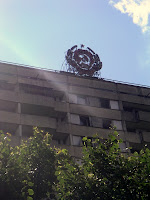
We drove down the Prospekt, which was slowly turning into a temperate jungle,shrubs, trees and grass invading the roadway, the pavements, the blocks of flats. On some of the roofs were still to be seen hammer-and-sickle signs, the last left in Ukraine, too dangerous to demount.

‘So there is really no-one here?’ came the question.

Iryna paused. ‘It is against the law for anyone to live here. Still, some people came back. They were born here, they didn’t want to live anywhere else. They came in illegally. They lived off the berries and the mushrooms in the woods. Although it was forbidden. Now eventually the government decided they were here anyway, they allow in some supplies for them, food, medical supplies, some social help. They are all elderly now, pensioners. But actually it is forbidden.’

When we reached the square we found another small bus there, with its tourist passengers huddled around it taking photos. ‘Actually it is not allowed to have more than one bus in one place, so we will take you to another part of the town.’ Thus we were fortunate to visit a far less frequented corner of the dead city, ulitsa Kosygin.

There followed a dreamlike and profoundly disturbing few minutes as we wandered up and down the road, venturing into some of the side streets – taking photographs of –what? Absences? Empty windows, children’s toys still lying in the undergrowth, a lush greenery we knew to be contaminated by radioactivity……

This was the catastrophe I had grown up through the ‘50s to the ‘80s fearing, along with all my contemporaries, the world when the Cold War had grown hot, human constructs without any humans after an atomic holocaust. Now here was a snapshot, secretly cordoned away in the Ukrainian countryside, that preserved that horrid, familiar nightmare……….

Tuesday, July 14, 2009

In the Exclusion Zone (2): Dining Out at the Chernobyl Reactor Site

In fact we very nearly didn’t get to eat at the Chernobyl plant, having spent so long dawdling at the Shelter Object and then at the newest building in the complex, presented by the European Union, the function of which is (or, to be more accurate, will be, as it won’t start actual operation until next year [maybe]), the processing of contaminated materials from the site. But it was formally opened in April so we were amongst its first visitors. We all immediately commented on the striking signing on the building, which was perhaps not entirely diplomatic in its effect. Inside was a nightmare of winding corridors and staircases taking us to the upper levels where people will be working. The materials – both elements of the closed reactors and other contaminated objects – are to be brought into the plant using systems which minimise human handling. They will then be placed by robots into concrete cylinders, which will themselves then be filled with concrete and stored in underground pits on the site which will then be topped up with further levels of concrete. By the time the 500-year half-life is over I imagine the European Union will no longer be around so that if the solution turns out to have brought with it more problems – as many of the ‘solutions’ to the Chernobyl disaster have done to date – there will be no one around to blame.

At least this facility has one useful button (pictured) which seems to have been lacking at reactor no. 4.

Our erratic progress brought about a crisis in logistics, and we were sternly informed by Iryna that we had time for lunch, or to see the Dead City, but not both. Emergency negotiations brought about the compromise that we could eat as long as we took no more than 25 minutes.

I must say that in many ways the Chernobyl Site Staff Canteen can be commended to the passing wayfarer, save that the reservation of tables by outsiders is exceedingly hard to obtain unless you have Iryna onside. Of course there is the drawback that, as elsewhere on the site, radiation levels are substantially higher than outside the exclusion zone; I don't know to exactly what extent, as the radiation control necklaces issued to us by Iryna when we arrived at the site were collected from us at the end of the visit without our being told how many roentgens we had absorbed.

But anyway, the taste of the food served up did not seem adversely affected. Indeed the meal – fresh salad accompanied by roulade of cream cheese and red pepper, borscht, chicken and roast potatoes, followed by a sort of sticky bun - was all extremely fresh, and was accompanied superbly by the only beverage on offer, bottled mineral water. The premises seem spotless. I read with interest the detailed sports fixtures of the Chernobyl site teams - for volleyball, soccer, swimming and chess – this necessitated me going down to the far end of the hall, away from the eating area; I couldn’t help noticing that Iryna got up to follow me to the noticeboard, in case I got lost, I suppose – very thoughtful of her. Service was very brisk – as my grandmother used to say, ‘like a yiddisher wedding’, with your plate swept up as you lifted the last forkful to your mouth. And the waitresses were remarkably good looking – a nice bonus for the regulars. An attractive feature of the canteen is the walk-in radiation monitor you can step into on your way out – when I tried it out (to Iryna's evident disapproval) the light flashed up 'chisto' (clean) which was reassuring.

(Next: The Dead City)

In the Exclusion Zone (1): The Shelter Object

Iryna, the lady from the Chernobyl International Relations Department piped out,’Please, I remind you, it is strrrrictly forbidden to take photographs of the Shelter Object from the windows of this room’. A number of my colleagues sheepishly turned their cameras towards the Chief Engineer at the site, to whom we were being introduced. ‘At about 01.23 Moscow time’ he told us, ‘on 26th April 1986, a meltdown in reactor no. 4 caused a huge explosion, lifting the roof of the pile, which weighed 3,000 tons, some tens of metres into the air and releasing into the atmosphere massive doses of radiation. At that time forty people were in or near building no. 4. Of one of them, no trace was ever found; it is assumed he was instantly incinerated. Of the others, 38 died in the next days and weeks of radiation poisoning. One alone survived 17 years, dying in 2003’.

‘And what did he die of?’ asked a Syrian journalist. ‘Delayed shock’ suggested the Israeli cameraman on my right, under his breath.

A less fatal delayed shock – plus some unavoidable interim travelling before I have found myself once more in London - leads me to write about my visit to the Chernobyl exclusion zone some five days after I left it.

Two hours drive out of Kyiv takes you to the outer checkpoint of the exclusion zone. Up to there the countryside seems perfectly green and bounteous by Ukrainian standards; as it does on the further side, with the qualification that there, there are no people. A further thirty minutes or so takes you to a broad canal with a perspective of industrial buildings in various states of deconstruction and a few more recent edifices. These are what is left of the four reactors of Chernobyl power plant, plus the buildings being constructed by international programmes to deal with aspects of the long aftermath of the explosion. Most striking is a large block of hunchback appearance with a tall chimney surrounded by scaffolding. This is the Shelter Object.

About the middle of May 1986 work began to enclose building no. 4 in an attempt to contain the radiation which it was still emitting in vast quantities. This enclosure, the result of which is now known as the Shelter Object, or more colloquially the Sarcophagus, took until November 1986. About 90,000 ‘volunteers’ took part in this phase, being exposed, especially in the first weeks, to exceptional doses of radiation, with the consequences which you would expect. It remains unclear exactly what they were told about the risks they were running. In the succeeding months, many hundreds of thousand of people worked at the site either in remedial work or simply in running the other three reactors, which (because Ukraine depended on them for its electricity) were not shut down until 1991 (nos. 1 and 2) and December 2000 (no. 3).

The west wall of no. 4, through which most radiation was coming, was hemmed in by massive blocks of reinforced concrete, which give the Object its lop-sided profile. Other parts of the building were also filled in or closed off by concrete. The design of the Object operations made no allowance for monitoring or fire systems. The consequence is that today almost half of the Object is inaccessible and no-one has any idea what is going on, in detail, inside it. A cutaway model in the exhibition room, where we were meeting the Engineer, gives a best estimate of the present state of affairs. It is known that water is rusting the steel of much of the reinforced concrete, so the building itself may be highly unstable and is at the risk of collapse. The Object remains full of radioactive and contaminated materials, so there is further risk of fire and/or a chain reaction. And it is estimated that the Object contains about four tons of radioactive dust which can leak through remaining air-conditioning structures, necessitating complex dust control procedures.
Now the only staff working at Chernobyl are associated with the international programme to contain and clean up the site. In this process dealing the Shelter Object itself is a major objective. It is to be enclosed yet again in a massive arch structure which should be completed by 2012 at a cost of $1.2bn. ‘Of course’, the Chief Engineer told us, ‘this cost and date are only indicative, since we have no way of finding the exact situation until we begin work.....’ The Arch is designed to have a life of 100 years – the half-life of much of the radioactive materials it will enclose is over 500 years. So we hope over the next century someone will come up with some good ideas.

(Next: Dining out at the Chernobyl site)

Wednesday, July 8, 2009

The tradition of woe

I am taking a trip tomorrow to Chernobyl, in the company (for reasons too complex and tedious to explain) of a group of journalists from Israel, Palestine, Syria and Egypt. Of course I will report back on this excursion - I am really not sure what to expect (of the place, that is - I have already met my travelling companions and they seem a great bunch).

But the prospect recalls a visit I paid a few years ago to the Chernobyl Museum here in Kyiv. It extensively set out the terrible damage that had occurred - loss of life, mass evacuation, children's illnesses, devastation of the environment though radiation, and so forth - but there was not the slightest attempt at analysis or explanation - why and how did the disaster happen? why was the reactor built at Pripyat (actually about 10 miles from Chernobyl, and now an extensive ghost town), what implications might the disaster have for the nuclear policy of Ukraine and its neighbours (which still rely extensively on atomic power for electricity generation)? It simply slotted nicely into the Russo-Ukrainian tradition of passively recounting woes loudly and at great length (and to some extent revelling in them). This sometimes seems to me something embedded in the Slav soul. When I first visited Russia in 1992 I was astonished to find in the precincts of monasteries and holy places old women begging for alms and wailing elaborately in the tradition which I had learnt of in 19th-century Russian novels. This practice of wailing had obviously been suppressed throughout the Communist era - but now it had sprung back, perfectly formed, having somehow survived underground. Misery must run in the blood.

A propos, having mentioned Ilf and Petrov's 'Golden Calf' in my last post, I should add that it features a band of con-men who form a 'League of Nephews of Lieutenant Schmidt' (a hero of the Revolution after whom a bridge in St. Peterburg is named), and divide up the territory of the Soviet Union so that only one in each area can claim alms on the basis of having this notable uncle. This tradition still lives on; apparently a number of people have made or still make a living claiming to have been one of the 'liquidators' who cleared the Pripyat reactor site. In fact around 750,000 people from the present Ukraine, Russia and Belarus were employed to carry out this task; of these genuine liquidators, maybe 30% or more are now dead or disabled.

Saturday, July 4, 2009

Khyorst

Having an idle hour to pass, I looked in at the Pinchuk Art Centre in the heart of town. This institution, set up by one of Ukraine's richest oligarchs (he is in the steel business and is married to the daughter of the discredited ex-President Leonid Kuchma), specialises in bringing fashionable culture to the capital, and to this end currently hosts a large display of the work of the British art publicist Damien Hirst, his name mysteriously trancribed into Ukrainian as 'Khyorst' although there would be a perfectly good way of representing it as it sounds in English. Perhaps it was avoided because it might suggest the word khiret' (to grow sickly).

Of the items exhibited I will write nothing because, in the wise words of Wittgenstein, 'About that which cannot be spoken of, one must remain silent'. My interest was more in the centre itself and the people visiting it. I note that the hype begins on the pavement outside; although there is plenty of space within,the doorkeepers are carful only to let in a few people at a time so as to keep a small queue in the street. In this queue I noted that I was at least twice as old as other visitors and this remained the case thoughout my visit. Entry is free by the way.

The items on display, set out over four levels (and continuing in a temporary display in the courtyeard of an adjacent shopping mall), attracted no detailed attention from the viewers - almost entirely male/female couples with a few pairs of female friends - who strolled through to complete the course and then left. Only a few studied the information on the computers in the gallery's reception, including heavyweight essays by English and German pundits and an interview with Hirst by Will Self. This includes Hirst's finely-wrought perception on Tony Blair: 'The lying c---. I hated all that spin. I just looked at him and thought, you're a fraud'. Takes one to know one, perhaps.

I was irresistably reminded of the Russian interpreter I used on my first visits to Moscow in 1992/93. A Gucci concession had just opened in the old GUM store alongside Red Square and Katya couldn't wait to see it. 'Look at these T-shirts' she squealed - perfectly anodyne items, but retailing at $100. Using my distant experience as a clothing manufacturer, I turned one inside out - the ragged hem was not even properly finished, and there were loose threads everywhere. 'Katya, this is utter rubbish. If you want a good T-shirt, I will buy you one at Marks and Spencer in England'.'Oh no, that won't do, this is Gucci!!'. The name and the fame was - and still is, it appears - the thing for wannabes in the new democracies.

But maybe I am being unfair. Not far away from the Pinchuk Centre, near the corner of Prorizna and the Khreschchatyk, is a statue to a well-known character in Russian fiction, the con-artist Panikovsky from Ilf and Petrov's 'The Golden Calf'. In the book Panikovsky stands on just this street corner posing as a blind man (as in the statue) and asking people to help him cross the road. Whilst they are assisting him he picks their pockets. Perhaps it is the native admiration for sheer chutzpah that makes the Kyivlans indulgent to Mr. Khyorst.

From Here to LA

I have just discovered that the Karaite Kenesa in Kyiv (now the House of Actors, see June 21st post) was in fact designed by one of the city's greatest architects, Vladislav Gorodetsky, born to a Polish-Ukrainian family in 1863, who also built the wildly eccentric ''House of Chimeras'' here, which will be food for a future posting.

As you can see from the picture (courtesy of WikiCommons) the Kenesa originally had a dome - this was lost or destroyed presumably during WWII, but indicates that the design of the building was almost certainly inspired by the Gur-e Amir mausoleum of Tamerlaine in Samarkand.

I have come across the Karaites twice before: once in the Crimea, whence they originate, and which still has a few traces of them, notably some sombre cemeteries. Some say they are descendants of the Khazars, the only state ever known to have converted to Judaism (about a thousand years ago). My second encounter was at the other end of Europe in Lithuania - at one stage the Lithuanian empire stretched all the way to the Black Sea and the King ordered a number of Karaites to come to his castle at Trakai and form his personal bodyguard. The kenesa at Trakai exists and still functions as such. I attended a Friday night service there and noted its close correspondence to an orthodox Jewish service. The main religious difference between Karaites and Jews is the fundamentalist approach of the former to the Bible, denying any authority to the Talmud or later Rabbinic interpretations. When I told the guy leading the service that I was Jewish he replied 'Oh yes, you guys are a bit like us'. He also informed me that these days the world centre for Karaites is Los Angeles, which I suppose is a step up from Trakai, Bakhchisaray or even Kyiv.

I asked how the Karaites were able to survive the Nazi occupation of the country in WWII. I was told the following remarkable tale:

The Germans weren't sure whether the Karaites qualified as Semites or not. The local Jews however pointed out centuries of Rabbinical decisions which stated that the Karaites were not acceptable in Jewish law for marriage to Jews, as they came of a different race. The Nazis accepted this - if the Jews would have nothing to do with them on racial grounds, then the Karaites could not be Jewish. In this way, although the Jews of Lithuania realised they themselves were doomed, they were able to save their distant 'cousins'.

Monday, June 29, 2009

Exhaustion

I have just been showing my parents round Kyiv. They gamely came out here for a long weekend after celebrating my father's 84th birthday. They wanted to see everything and they have left me quite exhausted.

Clearly they were fearing the worst - but they ended their trip absolutely delighted. It wan't just the sights - the Sophia Cathedral, the Andriyivsky Descent, the streets of Podil - though these of course went down well. Nor was it just the excellence of the concert at the Philharmonia or the opera (L'Elisir d'Amore with a world-class young local tenor, Dmitro Popov, as Nemorino). It was the overall atmosphere; compared, they said, to Krakow or St. Petersburg, the people were warm and friendly, the youngsters looked happy, they saw no signs of anti-social behaviour and the city, if in places a bit dilapidated, was generally clean. Above all they loved the architecture - the streets of late 19th century buildings with elaborate details, the amazing procession of Stalinist Gothic along the Khreshchatyk, the extraordinary creations of the architect Gorodetsky, the ensemble of (and the views from) the Pecherskaya Lavra. And whilst the weather was hot throughout, we also caught a spectacular thunderstorm,areal Kyiv special. Now if they could only improve the restaurants, and instal a few decent mid-price hotels, this could become one of the great destinations....despite the ongoing political and economic crises.

Sunday, June 21, 2009

Culture shock

Following Jonathan's very succesful recital on Wednesday (see post below - one member of the audience sweetly e-mailed me 'it was nice and wonderful. I got a lot of positive emotions') Friday's got off to a challenging start, with the enormous 'Concord' Sonata of Charles Ives and the terrifying Concerto for solo piano no.4 of Michael Finnissy. Introducing the concert I tried to prepare the audience for what to expect, telling them to look out for the hymns, rag-time and Beethoven in the Ives, and comparing the Finnissy to 'extreme sport' and commending its exhilaration (Russian word 'voozdushevlyayushchii', quite exhilarating in itself).

The Ives went like a dream -the roller-coaster of the Finnissy was not too much inhibited by my failure to turn page 12 in time (a moment of high drama which I hope has been captured in Yuriy's video of the event). It really is a shocking - in the sense of electrifying - piece - like the jazz pianist Cecil Taylor on speed. The audience more than rose to the occasion and gave Jonathan rapturous applause, (though there were a few quitters at the interval, including T. who gave the diplomatic excuse that she had to relieve her baby-sitter).

Those who stayed on, including the great Ukrainian composer Valentin Silvestrov (on the right in the picture above, with Jonathan after the recital), were treated to a magnificent second half which included music by Silvestrov himself (two serenades for solo violin beautifully performed by Sonia Suldina and a piece for violin and piano in memory of Tchaikovsky), and the heroic Symphony for solo piano of Alkan, one of the peaks of 19th-century romantic pianism. The audience left only after demanding two encores (Scriabin and Revutsky) with standing ovations.

An amazing and memorable evening which was subsequently celebrated, to the accompaniment of a good deal of vodka, at the highly commended 'Bundesbar' in Lysenko Street, including toasts to the British Alkan Society, who helped with sponsorship for this mini-tour.

Incidentally the location of the recital, the House of Actors (left), is itself a remarkable building - formerly the Kenesa (synagogue) of the Kyiv Karaites (a Jewish sect originating from the Crimea, none of whom alas seem to be left in the capital).

Thursday, June 18, 2009

After 100 years.....

In 1910 the young English composer Arnold Bax was in Russia when he encountered a beautiful Ukrainian girl, Natalia Karginska. Infatuated, he pursued her to Kyiv. The affair ended unhappily, but it did inspire him to write his first piano sonata. On Wednesday, after nearly a hundred years, this piece of British/Ukrainian music got its first performance in the city where it was composed. The idea was that of my friend, the gifted pianist Jonathan Powell, who when he heard I was coming out here asked whether it might be possible to arrange a recital. With the aid of local musical maven Yuriy Suldin we actually fixed up two concerts - the first one on Wednesday, when, apart from the Bax, (which turns out to be truly passionate and ends with the bells of Kiev pealing in all registers of the piano), Jonathan also played Rachmaninoff, Schubert, the Ukrainian composer (and teacher of Horowitz) Felix Blumenfeld, and works by the contemporary British composer John White and by Powell himself. The audience response on Wednesday was highly enthusiastic if slightly stunned!

Tomorrow's concert is even more challenging, including music by Ives, Alkan, Finissy and Konstantin Silvestrov. The Ives 'Concord Sonata' and the Alkan 'Symphony for solo piano' are two of the peaks of the romantic repertoire, enormously demanding in technique and interpretation. For the Silvestrov, Jonathan will be joined by members of the Ukrainian string quartet PostScriptum. Michael Finnissy's 'Concerto for solo piano no.4', which has been claimed as the most difficult piece ever written for the instrument, is the musical equivalent of 'extreme sport' ....It will be a test to see whether the audience and/or the piano survive. Or whether I do, as I wil be turning the pages.....

Thursday, June 11, 2009

Crossing the bar

Now for the next instalment of the enthralling saga of my attempts to cross the Slovak/Ukrainain border on foot (see this blog, March 22nd). Yes, I did say attempts, as I have tried again, in May, since I last reported to this blog. On this occassion I first took a look at the border at Cerny nad Tisou but this apparently can only be accessed via rail, and most of the time they seem to cancel the trains (which even when they are running go at unearthly hours such as 05.32 or 23.17). So back to the Uzhorod crossing where, once again blocked by the EU side as a pedestrian, I hitched a lift and crossed as a passenger of a very friendly Ukrainian who not only also gave me a brief guided tour of the town's historic sights, but refused to accept any payment. Many thanks, Ihor!

Today however I received astounding news. My excellent Euro MP (just reelected with a huge vote) Charles Tannock, took up my cause at the European Parliament and received the following response:

According to the information notified by Slovakia, there is no limitation on the use of the border crossing point at Vyšné Nemecké-Užhorod.

As far as local border traffic is concerned, Slovakia and the Ukraine have concluded a bilateral agreement on local border traffic in order to ease trade, social and cultural interchange and regional cooperation. The agreement is applicable to persons lawfully resident in the defined Slovak and Ukrainian border areas.

The Commission will address the Slovak authorities in order to receive clarifications concerning the reported restriction of use by pedestrians of the above-mentioned border crossing point.


That'll teach them all a lesson......

to the faithful......

As I now seem to have four (or is it three) followers, I suppose I must do my duty by them - but first, an explanation (or excuse) for my absence.

I have been transfixed by the slo-mo gory unfolding of British politics. Having in my time played a bit-part in this long running soap opera, I have not been at all suprprised by the expenses, the briefings, the backstabbings, etc. Been there and done that (and had it done to me), albeit at a local, not a national, level. But what has astonished me has been the utter incompetence of the various plotters involved in the Labour Party. Getting rid of a man at the top is hard work, particuallry when s/he holds so many of the necessary strings. In my day we spent weeks in advance canvassing, blackmailing, making promises etc. and staged the moment when we could bring it all into play. These tossers seem to have thought that all they had to do was come out in a tizzy, strike a pose and tell a sob-story to the press, and that everything would then simply fall into place. They just don't have a clue - once again King Log triumphs over King Stork.